
Disappearing Data, Toxic Workplaces, and More
Hello again from the flooded zone.
We’ve been thinking a lot about how to make this newsletter as useful as possible to y’all during these destabilizing times. Our original goals were to 1) share our views/thoughts on what’s going on inside this country’s sprawling criminal legal system with the journalists who cover it and the people who care about it and 2) highlight public safety issues that don’t always get covered as such, like rising temperatures, Medicaid access, lead contamination, etc. Even in the midst of all this chaos, we still think those are important goals. (Maybe even more so given how hard it is to keep track of everything that’s happening right now?! The phrase “drinking from a firehose” currently seems like a… dramatic understatement.)
So: today we’re going to talk about some of the public safety issues that the U.S. has historically dealt with through regulation, and highlight how things are changing under the current administration. We’re thinking about things that are controlled in such an under-the-radar way that we’re not usually aware that they’re happening, like inspecting the food in our grocery stores, testing our kids’ toys for dangerous chemicals, and staffing air traffic control towers. These layers of regulatory oversight, testing, and quality control are largely invisible, except when they fail. That means that people are unaware or even mistrustful of these systems, making them particularly vulnerable to erosion in moments of heightened skepticism, and that’s exactly what we’re seeing today. After January’s devastating fires in LA, for example, the federal government made the decision to stop testing the topsoil left in the fires’ wake. It’s easy to assume the soil is full of toxins, but knowing which toxins, in what concentrations, and where they pose the greatest risk is critical—not just for mitigation, but for holding industries and policymakers accountable.
Alongside the erosion of regulations that impact air, water, and food (just those little things that, you know, we all need to live), the data that would allow journalists and others to track these safety issues is getting harder to come by. The Trump administration has been fairly aggressive in removing government data from public websites – from environmental mapping tools to crime prevention research to resources on opioid addiction and reproductive healthcare to basically any Spanish language information on WhiteHouse.gov. At the same time, states across the country continue to whittle down their open records laws. This gradual shift away from transparency leaves people to fend for themselves, navigating risks with incomplete information. And that’s the real danger: when data becomes harder to access so does safety itself. There are a million ways to illustrate this, but we’re going to briefly get into opportunities for reporting on chemical exposures in workplaces – a great example of something you can’t really protect yourselves from if the risk is being hidden from you.
Before we do that, we’d feel strange not mentioning, albeit briefly, the recent detention of student activists and deportation of hundreds of Venezuelan men to a mega-prison in El Salvador, given their sharp break from (an already bleak) precedent. More on how these actions are explicitly and implicitly related to the criminal legal system in our next newsletter. As always, if you’re hearing things, or seeing things that need coverage, please let us know. Local, state, federal - we want to know more.
Toxic Workplaces
We’re all exposed to harmful substances. The presence of phthalates—chemicals linked to reproductive issues, immune disorders, and cancers—in nearly every processed food Consumer Reports tested last year is just one example of a massive, ongoing public safety failure. The federal government has banned phthalates in some products, like children’s toys, but there are still no substantive limits on their use in food packaging and processing. The result? Nearly unavoidable exposure to toxic substances—exposure that disproportionately impacts working-class people, particularly those with fewer food options or who work in industries that involve exposure to these chemicals.
Workplace exposure to toxic chemicals is responsible for thousands of deaths and millions of illnesses in the U.S. each year. Globally, exposure to hazardous chemicals at work is estimated to cause over 370,000 premature deaths annually—almost as many as the estimated 450,000 homicides worldwide. These risks are far from evenly distributed. A recent NIH study examined the levels of toxic chemicals in the blood of workers across different industries, comparing traditionally “blue-collar” jobs (such as construction and firefighting) with “white-collar” jobs (such as office work) and those who were unemployed. The findings were striking: many blue-collar workers—and, notably, unemployed people who were either on disability, laid off, or unable to work for health reasons—had dangerously high levels of toxic biomarkers like arsenic and lead, exceeding safe thresholds.
Opportunities for Reporting
Track the regulatory failures. Which agencies are supposed to oversee workplace chemical exposure, and where are they falling short? Investigate patterns of lax enforcement, industry lobbying influence (more on this below) and how often violations result in actual penalties — especially as we’re seeing some of those regulatory agencies hollowed out.
Follow the lawsuits. Major lawsuits can reveal how companies downplay risks and fight accountability. Agricultural workers, for instance, face routine exposure to hazardous pesticides and herbicides, including paraquat—a chemical linked to kidney damage, respiratory illness, and potentially Parkinson’s disease. The manufacturer of paraquat is currently facing over lawsuits from more than 4,000 farmers who have developed serious health conditions after years of exposure.
Investigate worker-led organizing. How are workers fighting for safer conditions? Are unions, grassroots groups, or advocacy organizations mobilizing around chemical exposure? Get to know people doing that kind of organizing in your community. Also, explore disparities in exposure. Who is most affected by toxic workplace conditions? Cover the strategies people fighting for safer conditions are using and the challenges they face.
Follow the revolving door between regulatory agencies and industry lobby groups. This context is important, and under Trump 2.0, it’s exemplified by people like Lynn Dekleva, a former industry operative lobbying for formaldehyde who is now approving new chemicals at the EPA.
For an excellent example of this kind of coverage, Carey Gillam at The Guardian has covered paraquat’s devastating impact, the lawsuits against its manufacturer, and the industry’s broader attempts to downplay health risks. Gillam’s work is part of The Guardian’s "Dirty Divide" series, which highlights the unequal environmental and health burdens placed on marginalized communities.
Everything Old is New Again
We’re running a new series here where we draw connections between past and present, through the lens of the news media. We’re rehashing so many of the same debates, with the same arguments, the same scare tactics, and even the same language. Take, for example, immigration. A few relics we’ve found:
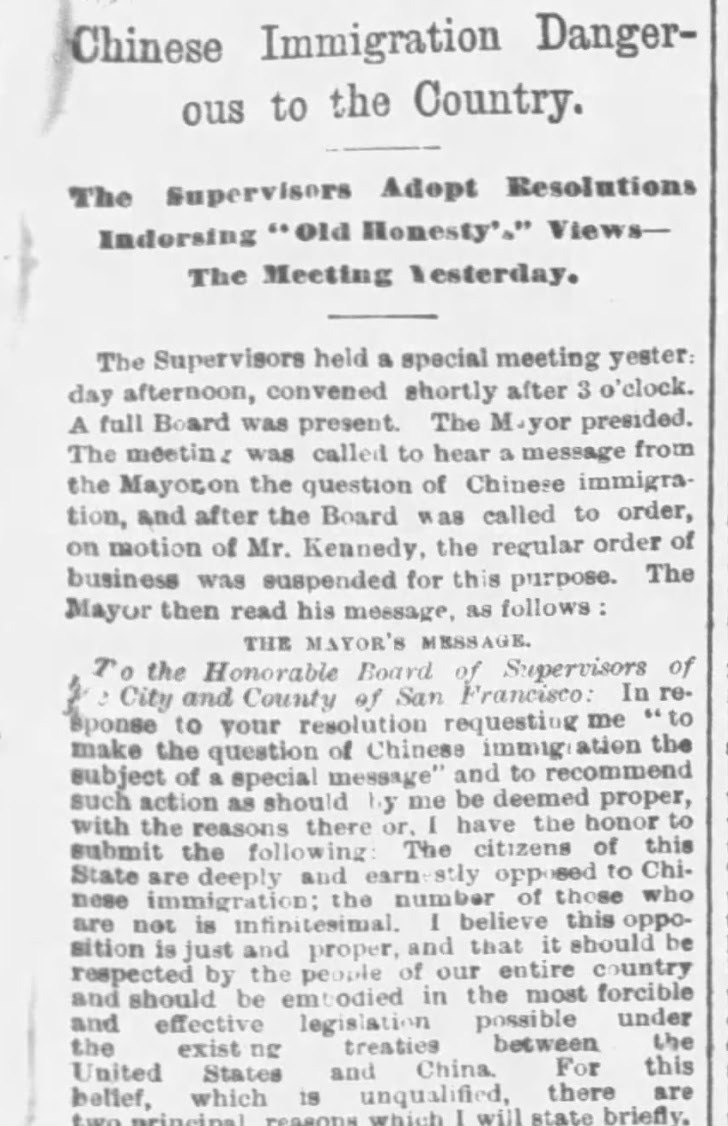
Here’s an 1882 article (if you can call it an article – it’s mostly just regurgitating racist rhetoric) from the San Francisco Examiner, about the Mayor’s speech on Chinese Immigration. Headline: “Chinese Immigration Dangerous to the Country.”
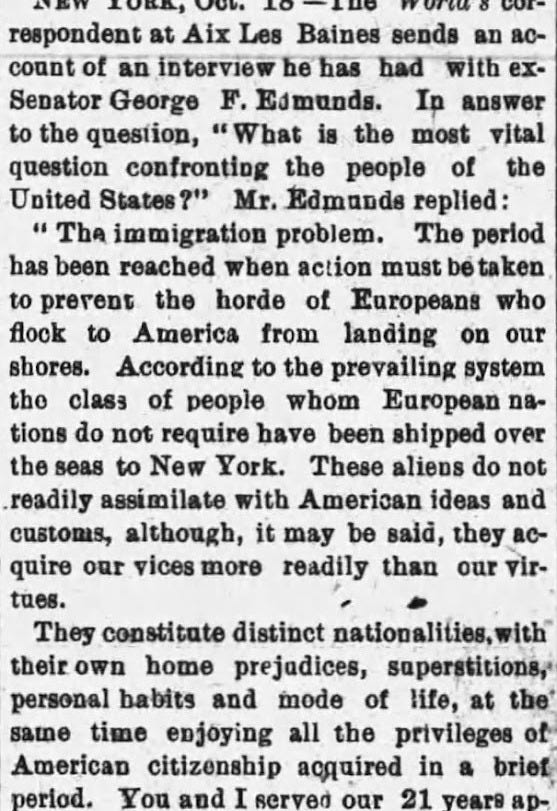
And this excerpt from an 1892 article in the Fall River Daily Evening News, featuring an interview with former Senator George F. Edmunds of Vermont, warning people against the “horde of Europeans” soon to descend on the United States, who “do not readily assimilate with American ideas and customs.”
Two things jump out to us from these clips. First, this is the same kind of tired language we hear today from government officials about the people they are detaining and deporting—sometimes in defiance of court orders—claiming they are here to “create havoc” and “unsettle the United States.” Second, the journalists who wrote these pieces didn’t fact check or contextualize the claims made by government officials. The wholesale reprinting of official statements might be less common now, but single-sourced stories certainly still exist and too many contemporary news stories fail to place the claims of government officials in the context of readily available evidence that either supports or refutes their claims.
On a kind-of-related and final note: we really appreciated this piece from The Verge. After Trump fired Federal Trade Commissioners earlier this week, readers pointed out that putting the word ‘illegal’ in quotes in the headline sort of neutered the sentiment – it was in violation of longstanding SCOTUS precedent, and that wasn’t just a claim from the fired parties. “Although these are unprecedented times,” Sarah Jeong writes, “a news headline should not quietly aid the erosion of our social consensus about the law, even if we ourselves are struggling to do our jobs because of that erosion. […] What the Trump administration is doing is beyond abnormal. The Supreme Court, too, has enabled and fueled the downward spiral, upending bedrock principles of how we organize our society and blowing up the predictive value of the law as we know it. And if our headlines don’t convey this existential fact to you, the reader, then we’re still writing our headlines wrong.”
As a data journalist, I love this line: "when data becomes harder to access so does safety itself." Great read, thank you